Reporters
Reporters receive events from the test runner — the planned test count, test start, checks, HTTP/gRPC calls, retries, results, and the final summary — and turn them into output. You can enable several at once.
Built-in reporters
| Name | Description |
|---|---|
live |
Default on an interactive terminal. Keeps a live view at the bottom of the terminal: one line per running test (with elapsed time and retry count) and a progress bar with passed/failed counts. Failures are printed in full above it as they happen, with captured HTTP logs (depending on --capture-http), followed by a summary. Passing tests, including ones that passed after a retry, leave nothing behind. With --capture-http all, every HTTP/gRPC call appears as one line (method, status, URL, duration, test) in a fixed-height http window, and with --capture-rust, the latest Rust logs appear in a logs window; both disappear when the run ends. Use --reporters list to keep full output. |
list |
Default when stdout is not a terminal (CI, pipes, files). Prints one line per test as it finishes, followed by captured HTTP logs (depending on --capture-http) and a summary. |
When --reporters is not given, tanu picks live if stdout is a terminal, and list if it isn't, if the CI environment variable is set, or if TERM=dumb. Pass --reporters list to get per-test output in a terminal.
Allure
tanu-allure writes Allure-compatible JSON for each test. HTTP calls, assertions, and timings appear in the Allure dashboard without extra plumbing.
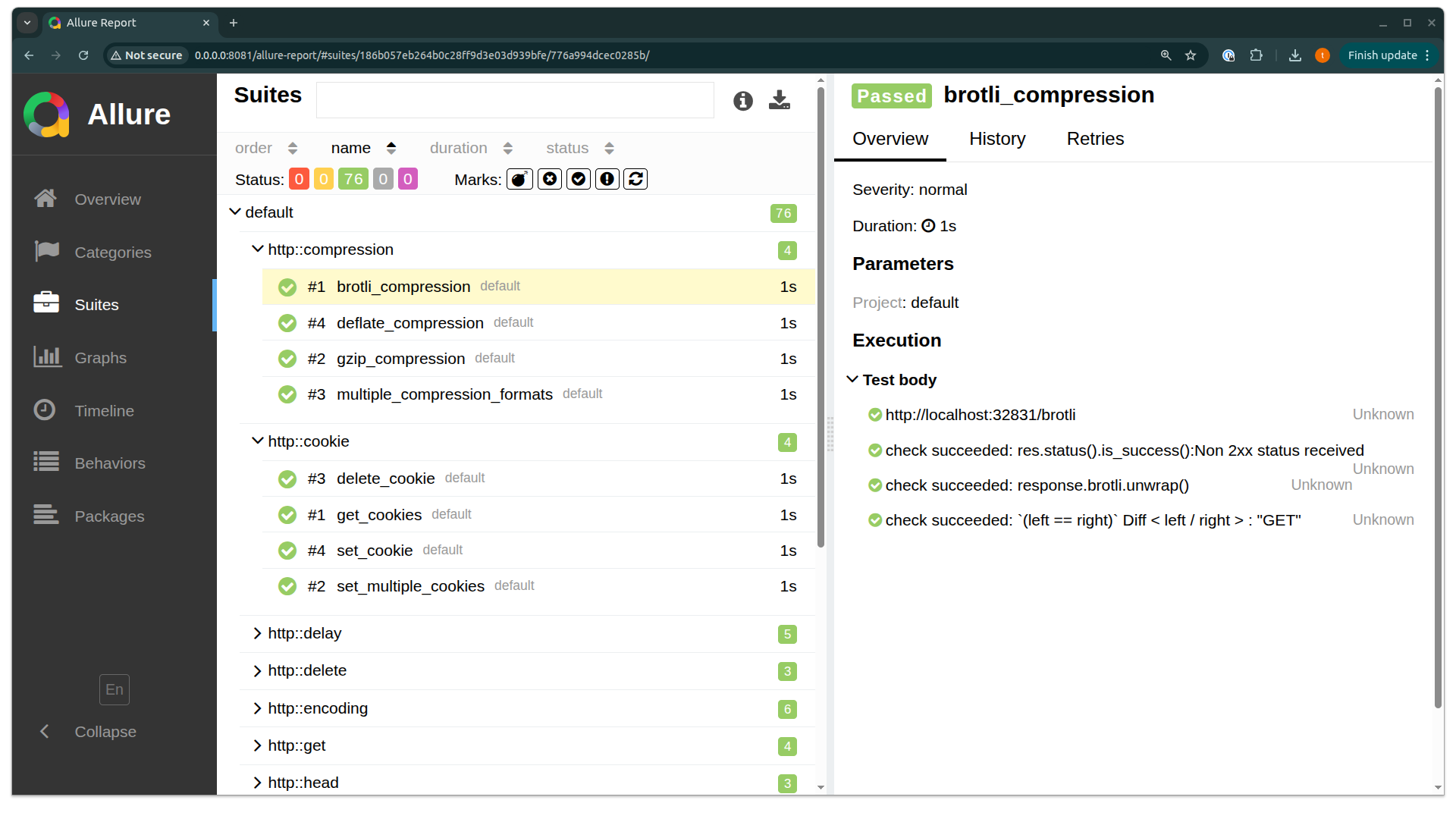
Add the crate:
Register the reporter in main:
#[tanu::main]
#[tokio::main]
async fn main() -> tanu::eyre::Result<()> {
    let runner = run();
    let mut app = tanu::App::new();
    app.install_reporter(
        "allure",
        tanu_allure::AllureReporter::with_results_dir("allure-results"),
    );
    app.run(runner).await
}
Run the tests with the reporter enabled, then generate or serve the report with the Allure CLI:
See the tanu-allure repository for the latest version and a GitHub Actions workflow that publishes reports to GitHub Pages.
Writing a custom reporter
Implement the Reporter trait. Every method has a default implementation, so override only the events you care about:
| Method | Called when |
|---|---|
on_start |
A test starts |
on_check |
A check! macro succeeds or fails |
on_call |
An HTTP or gRPC call completes |
on_retry |
A failed test is about to be retried |
on_end |
A test finishes |
on_summary |
All tests have finished |
use tanu::{async_trait, eyre, reporter::Reporter, runner};

#[derive(Default)]
struct FailureCounter {
    failed: Vec<String>,
}

#[async_trait::async_trait]
impl Reporter for FailureCounter {
    async fn on_end(
        &mut self,
        project: String,
        module: String,
        test_name: String,
        test: runner::Test,
    ) -> eyre::Result<()> {
        if test.result.is_err() {
            self.failed.push(format!("[{project}] {module}::{test_name}"));
        }
        Ok(())
    }

    async fn on_summary(&mut self, summary: runner::TestSummary) -> eyre::Result<()> {
        println!("{} of {} tests failed", summary.failed_tests, summary.total_tests);
        for name in &self.failed {
            println!("  {name}");
        }
        Ok(())
    }
}
Install it under a name, and select it with --reporters: